Algeria's bronze, at the end of a long night
Par Chahinez Aoussat · August 18, 2026 à 11:02 AM · 6 min de lecture
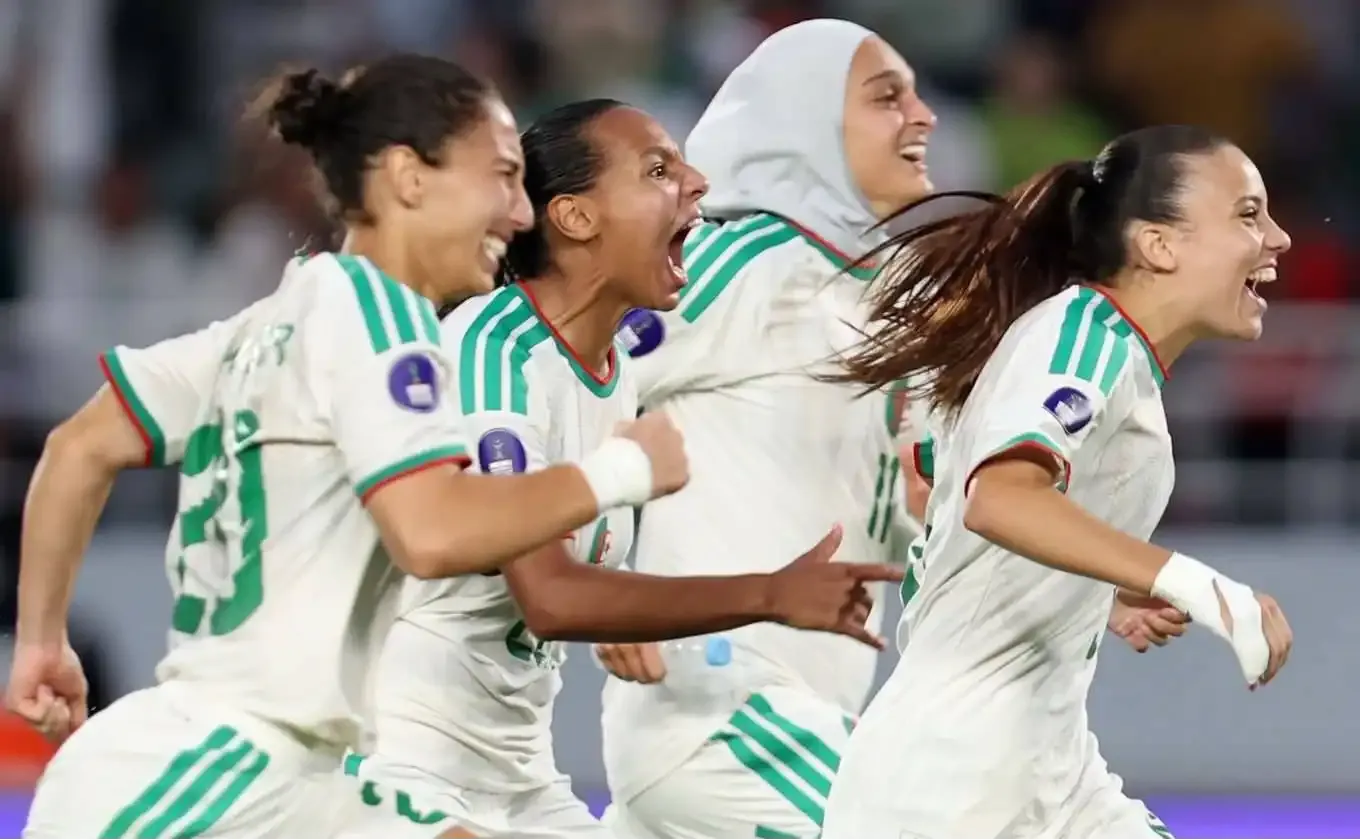
Beating Morocco on penalties at Rabat's Olympic Stadium, Algeria took the first medal in the country's history at the Women's Africa Cup of Nations. A portrait of the generation that moved the goalposts.
It probably took a script like this one to close out a month of football like this one. In front of an Olympic Stadium in Rabat that belonged entirely to the Atlas Lionesses, the Algerians spent the first half absorbing punishment: a high Moroccan block, suffocating pressing, and a scare inside three minutes when a misunderstanding between Lana Smits Ouraghi and her goalkeeper handed the ball to Ibtissam Jraidi — only for Chloé N'Gazi to get a foot in at exactly the right moment.
Morocco opened the scoring in the 37th minute through Kautar Azraf, an 18-year-old forward, with an unstoppable curling finish off her left foot. By half-time Algeria had shown almost nothing. It was the second half that changed the colour of the medal: a vicious cross from captain Marine Dafeur, then a first strike from Lina Boussaha, then a volley the same player put well over — and then the third attempt, the right one. In the 83rd minute, running the offside line, the PSG-schooled forward equalised with the composure of a veteran.
The worst and the best were still to come. A penalty was awarded to Morocco deep in stoppage time after slight contact between Sakina Ouzraoui Diki and Smits Ouraghi: Nouhaila Benzina hit the post. Then came the shoot-out, chaotic and full of misses, in which Morocco's Najat Badri struck the crossbar. Morocco, beaten finalists on home soil in both 2022 and 2024, finished their own tournament fourth. Algeria stood on a continental podium for the first time.
LINA BOUSSAHA: COMPOSURE AS A SIGNATURE
She is the public face of this team, and she did what you want from an attacking leader: miss twice, keep going, and score at the exact moment the match was dying. Developed at Paris Saint-Germain, she spent time in the Saudi league before joining Al-Ittihad, and arrived at this tournament carrying a level of exposure and pressure few of her team-mates know. She leaves it with the goal that made the medal possible, and with a role that has shifted: less of an orthodox winger, more of a player working between the lines, able to run in behind a defence that pushes up. Her influence had already been clear in the opener against Senegal, where she set up Mélissa Bethi for the second goal.
MARINE DAFEUR: THE METRONOME AND THE ARMBAND
If one player sums up this team's transformation, it is probably her. The Bristol City midfielder was involved in almost everything dangerous Algeria produced: a converted penalty against Senegal, a 30-yard free-kick against Kenya that went around social media, the assist for Amira Ould Braham in the quarter-final, and repeated risk-taking in the third-place match. She took the armband after Sofia Guellati's injury, and she took the game with it.
Her value is less athletic than decisional: she is the one who decides when the team accelerates, when it drops, when it gambles. In a squad that long lacked technical reference points in tight moments, that is a luxury.
Four goals across the tournament, four different scorers, several of them off the bench.
THE REAL MEASURE OF ALGERIA'S PROGRESS
III. CHLOÉ N'GAZI: THE GOALKEEPER WHO HELD THE THREAD
Goalkeepers are usually judged on spectacular saves; the Montpellier keeper was, above all, reliable whenever her team dropped deep. The decisive intervention on Jraidi in the third minute, the stops before half-time against Kenya, the command of her box through the final twenty minutes against Morocco: without her, the shoot-out never happens. Algeria's bronze was decided on details of that size.
SQUAD DEPTH AS A WEAPON
The real marker of progress at this tournament is not the star names but what the substitutes contributed. Inès Khiri, barely on the pitch, equalised in the 58th minute of the quarter-final against Côte d'Ivoire. Amira Ould Braham followed six minutes later, served by Dafeur, and sent Algeria into the semi-finals — and to the World Cup. Mélissa Bethi settled the opener against Senegal late on. Lynda Bendris doubled the lead against Kenya.
That is precisely what Farid Benstiti was after when he changed seven names from his previous tournament list: a second unit capable of turning a match, rather than dependence on a rigid starting eleven.
THE DEFENSIVE BASE
This team's identity was built from the back first. Sofia Guellati, centre-back and captain, had to come off in the seventh minute against Kenya, an injury that reshuffled the hierarchy. Roselene Khezami stood out for decisive recovery defending and for speaking like a senior professional to the press at the tournament's most delicate moment, the day after the derby defeat. Inès Belloumou, Mélinne D'Oria and Lana Smits Ouraghi completed a unit that conceded little, the semi-final aside.
Smits Ouraghi, in particular, illustrates how unforgiving the top level is: involved in both of the most dangerous sequences of the third-place match, she finished it with a bronze medal around her neck. Football does not always trouble itself with accounting justice.
WHAT THE SQUAD'S MAKE-UP SAYS
This team is overwhelmingly drawn from the diaspora: French, English, Swiss, Turkish and Saudi clubs. The Algerian federation has openly pursued that route for years, and it is one explanation for the jump in level, since these players train daily in professional structures. Players from the domestic league, such as Khouloud Ournani, remain a small minority — and that is probably where the next project lies: turning success built abroad into a durable pathway at home.
Farid Benstiti's work, as the French coach who has now been in charge for several seasons, comes down to one line: collective discipline, a clean-sheet culture, and a gradual injection of youth around an experienced core. In 2025 Algeria reached their first quarter-final. In 2026 they eliminated Cameroon in qualifying, came through the host nation's group, turned around the tie against Côte d'Ivoire and came home with a medal.
AND NOW, BRAZIL
Qualification for the 2027 World Cup was already secured by reaching the last four. The semi-final loss to Malawi — the tournament's revelation and beaten finalist, thrashed 3-0 by a Cameroon side crowned for the first time in their history — was the only genuine setback, the physical and emotional cost of a month of football against a team that simply moved quicker.
The bronze itself adds nothing to the world ranking, but a great deal to everything else: proof, taken in a derby, in a hostile stadium, against a better-resourced side that had reached two finals. This group now has a little under a year to move from being a team that surprises to a team that expects to win. The difference between the two is rarely about talent. It is about what these players showed in the 83rd minute in Rabat, when nobody believed any more that they could come back.